
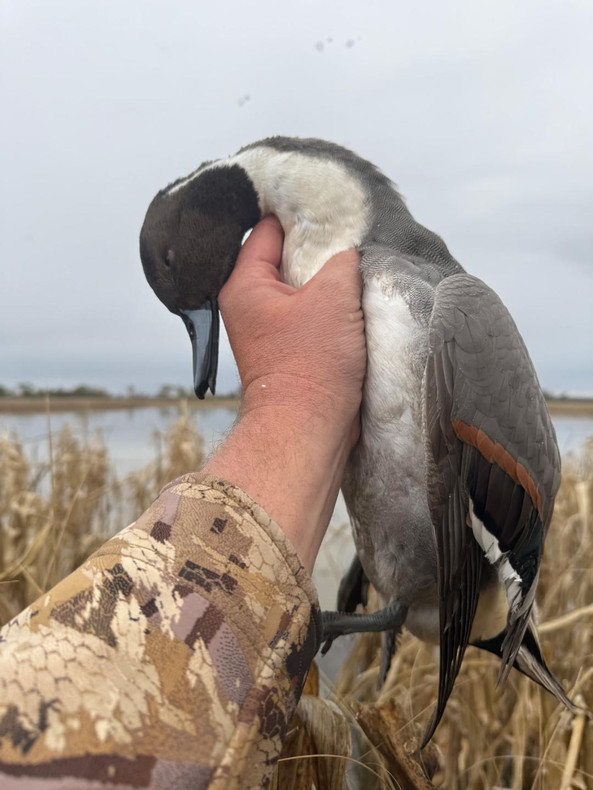
Throughout the country, pintails are a highly prized species by hunters, but the long-term population decline has necessitated much more restrictive hunting seasons compared to most other duck species. The reason they are not thriving like other puddle ducks is because they are being “misled” by modern cropping methods and climate change into choosing risky nesting habitats.
Pintails typically inhabit marshy areas, lakes and reservoirs where food is plentiful. They eat in shallow water during the night. In winter they eat mainly plant material including seeds and rhizomes of aquatic plants but may sometimes feed on roots and grain. During the nesting season, they mainly eat invertebrate animals.
Migratory habitats range from inland freshwater to areas that are protected from strong wind, mostly around shallow water bodies. During the summer they are plentiful in Quebec, Alaska, the Great Plains, Northern parts of Asia and Europe. During the winter they prefer brackish marshes, estuaries and costal lagoons in tropical regions of South Asia, Africa and Panama. They regularly visit Northern Columbia, Central America and regions in the Caribbean as well. From September to March, Northern pintails migrate to India.
Adult pintails are creatures of habit and revisit their nesting site every season, if conditions are favorable. They often initiate nests before remaining stubble fields are worked by farmers in the spring. The nests are then vulnerable to mechanical spring tilling and planting of remaining standing stubble. Climate change allows farmers to till and plant earlier in the spring. A warmer pre-spring can also lead to a mismatch between nesting activities and food availability.
Mating behavior
- The male whistles and approaches the female with his tail lifted and head lowered.
- After copulation the males lift their head high following it up with whistles.
- Mate with multiple females each season
Breeding
- Eggs are typically laid in spring from late April to early June in shallow wetlands. They are laid in nests tucked away in vegetation away from water.
- Hatching is synchronized with the appearance of insects and the growth of aquatic plants, ensuring an abundant food supply
- Females typically lay 7 to 9 eggs, although clutch sizes can range from 6 to 12 eggs. Pintails usually produce one brood per year but may attempt a second if the first is lost.
- The number of eggs depends on age, health, and the availability of food resources. Older, more experienced females tend to lay larger clutches.
- Eggs are small, oval-shaped and typically an olive-buff to pale greenish color.
Average length is 55 mm and 38 mm wide. The smooth, non-glossy shell helps provide camouflage.
- Incubation period is 3 to 4 weeks. Survival rate depends on predation, weather conditions, and food availability.
- Ducklings hatch with their eyes open and are covered in down feathers. This allows them to quickly leave the nest and follow their mother to nearby water, where they can eat and are better protected from predators (bigger birds, foxes and bobcats)
- During the period between hatching and fledging, the ducklings grow rapidly, replacing their down feathers with juvenile feathers. They learn to dive and forage under their mother’s guidance, gradually becoming more independent.
- Ducklings fledge about 38 to 52 days after hatching. However, they may stay with their mother for several weeks afterward. As their flight feathers and muscles develop they become more capable of escaping predators and exploring their environment.
Pintail ducks get their name from their distinctive tail, which is long and pointed. Both males and females have long, pointed tails; however, the breeding male has a much longer, more prominent tail than females or non-breeding males. Breeding males have a white chest with a white line going down their brown head and neck. Females and males that are molting have unmarked pale tan faces with blotches of brown and white and dark bills. The structure of the bill enables them to locate, manipulate and filter food from the water. They have several adaptive features such as secondary feathers to help lift their bodies and a respiratory tract to supply excess oxygen during migration.
Behavior
- Are social and form large flocks when they are not breeding
- Walk and run with a slight wobble.
- Habitually quiet with an occasional low-pitched whistle or hoarse quack.
- Males leave females behind to molt and do not fly for 4 weeks.
Farming with a wholistic approach will preserve the environment and create a more balanced ecosystem. Farmers can practice regenerative agriculture to help restore the ecosystem, feed families and improve livelihoods. This can be accomplished by understanding environmental education, agroforestry, diversification, and reforesting.
Sources:
https://www.animalspot.net/northern-pintail.html
https://binocularbase.com/pintail-life-cycle/
https://www.ncwildlife.gov/species/northern-pintail
https://www.techexplorist.com/early-nesting-ducks-danger-due-climate-change-land-use/59375/
https://www.sustainableharvest.org/mission